🗓️ November 30, 2025
🏁 Kilometers : 891
This Sunday morning begins with beautiful weather. I set off at 7:00 AM and have the choice of either hiking just 16 km to a sort of hangar that could serve as a campsite, or 35 km to a village called Waitomo. For the first 10 kilometers, a gravel track allows for quick progress, followed by a relatively well-maintained trail. I arrive at the hangar by 10:45 AM, so it is only logical that I decide to continue to the village of Waitomo.
As the day progresses, the beautiful blue morning sky gives way to a cloudy ceiling, which in turn gives way to thick gray clouds that seem laden with rain. It starts as a light drizzle, then becomes heavier, and finally turns into a veritable torrent. As if to compound the difficulties, the easy morning trail transforms into a muddy and slippery track. The rain soaks me from above, while the vegetation along the path spray me from the sides. The trail winds through dense thickets of Manuka trees, so tightly packed that it becomes difficult to find the path, climbs long, muddy slopes, crosses numerous forests, and cuts across a stream.
For the last 5 kilometers, I reach a gravel path. It seems the rain waited until I was out of the forest to intensify and fall as if I was walking fully clothed into the shower. I quicken my pace to reach the campsite as soon as possible.
When I arrive at reception, the receptionist must be quite amused by my miserable, wet-dog appearance. I take a cubicle, spread out my clothes to try to dry them, rush to the shower, and return to reception to buy a bag of chips and three tubs of ice cream, which I devour immediately. It's silly, but it's good!
🗓️ December 01st, 2025 (day off trail)
Waitomo, the village where I'll be taking my rest day, is internationally renowned for its caves whose ceilings are covered in glowworms. We'll be visiting them tomorrow with three other hikers who are a day behind me, hence the decision to take a day zero. Another reason is that I forgot my sunglasses at the previous campsite, so I decide to hitchhike to get them. Five different drivers give me a lift, including a young Maori driver who's a bit too enthusiastic behind the wheel and an American retired couple who decided to apply for New Zealand citizenship after Trump was elected president. The return trip is much easier; a single driver, who was also heading to Waitomo, gives me a lift back to my starting point.
My friends who were a day behind me arrive at the campsite, and I share my cabin with them. In the evening, we head to the local pub for a round of cider and beer before going to bed.
🗓️ December 02, 2025
🏁 Kilometers : 906
At 8:00 a.m., the four of us—Helene from Australia, Jolly from the United States, and Ben from Germany—meet in front of the offices of the company that organizes tours of the Waitomo Caves. Several options are available: the classic, most touristy tour, which lasts only 45 minutes, or a 3-hour caving expedition. We choose the latter and are equipped with full neoprene suits, including boots and helmets with lights. We also receive inner tubes to help us float on the underground river. Having booked the first slot of the day, we are alone exploring the caves, along with our three guides, all in their twenties.
Laughter erupt during the briefing, but seriousness returns as we enter the small natural opening where a stream plunge underground. The first steps in the dark are daunting; the faint glow from our helmets doesn’t seem to illuminate much for our eyes, unaccustomed to the darkness. We follow our guides through a natural, circular passage, somewhat reminiscent of a Parisian sewer pipe, with the water up to our ankles. We navigate a few bends and hear the ominous roar of a waterfall growing closer, created by another stream that, seeping through the limestone, swells the level of the main river. Being a small group, the guides have time to show us additional hidden corners, such as contorting ourselves through rocky crevices to pass under the icy waterfall, or taking an adjacent passage that forms a kind of loop, which we have to crawl through to get out… guaranteed thrills! Claustrophobes beware!
We take a short break, and our guides hand out fish-shaped marshmallows (apparently, in New Zealand, marshmallows aren't shaped like teddy bears—how strange!). They ask us to turn off our helmet lights; we're now in complete darkness… or what we think is complete darkness. Because when we look up, we discover a magical sight! A multitude of glowworms shine on the rounded ceiling of the cavern, forming small, irregular groups of varying sizes and shapes, appearing like tiny constellations amidst a majestic Milky Way. The unsettling feeling of being underground instantly transforms into dazzling wonder.
We remain silent for a moment, admiring this astonishing spectacle, followed by an explanation of the phenomenon from one of the guides. The Waitomo glowworm is a species of midge that looks more like a maggot. It emits bioluminescence to attract prey in its larval stage and to find a mate when it transforms into an adult insect. The larvae feed by each producing several small threads covered in sticky liquid that trap their prey, or simply by devouring their own kind.
Nature has inexhaustible resources and never ceases to amaze us!
We continue our exploration of the caves, using our hands and feet. Twice, we have to jump into the water backwards, holding our buoys by our buttocks, from small waterfalls, all in the dark. We also have to lie on our buoys, stomachs facing the very low ceiling, and propel ourselves forward using our hands. As the water level rises, we can drift along on our inner tubes, admiring the starry ceiling in a state of blissful laziness.
And then daylight appears, the end of the tunnel visible behind a few stalactites. We emerge from the cave with the feeling of having had an extraordinary experience! We take a few more photos, change out of our wetsuits into our hiking clothes, and are treated to a hot shower and some soup.
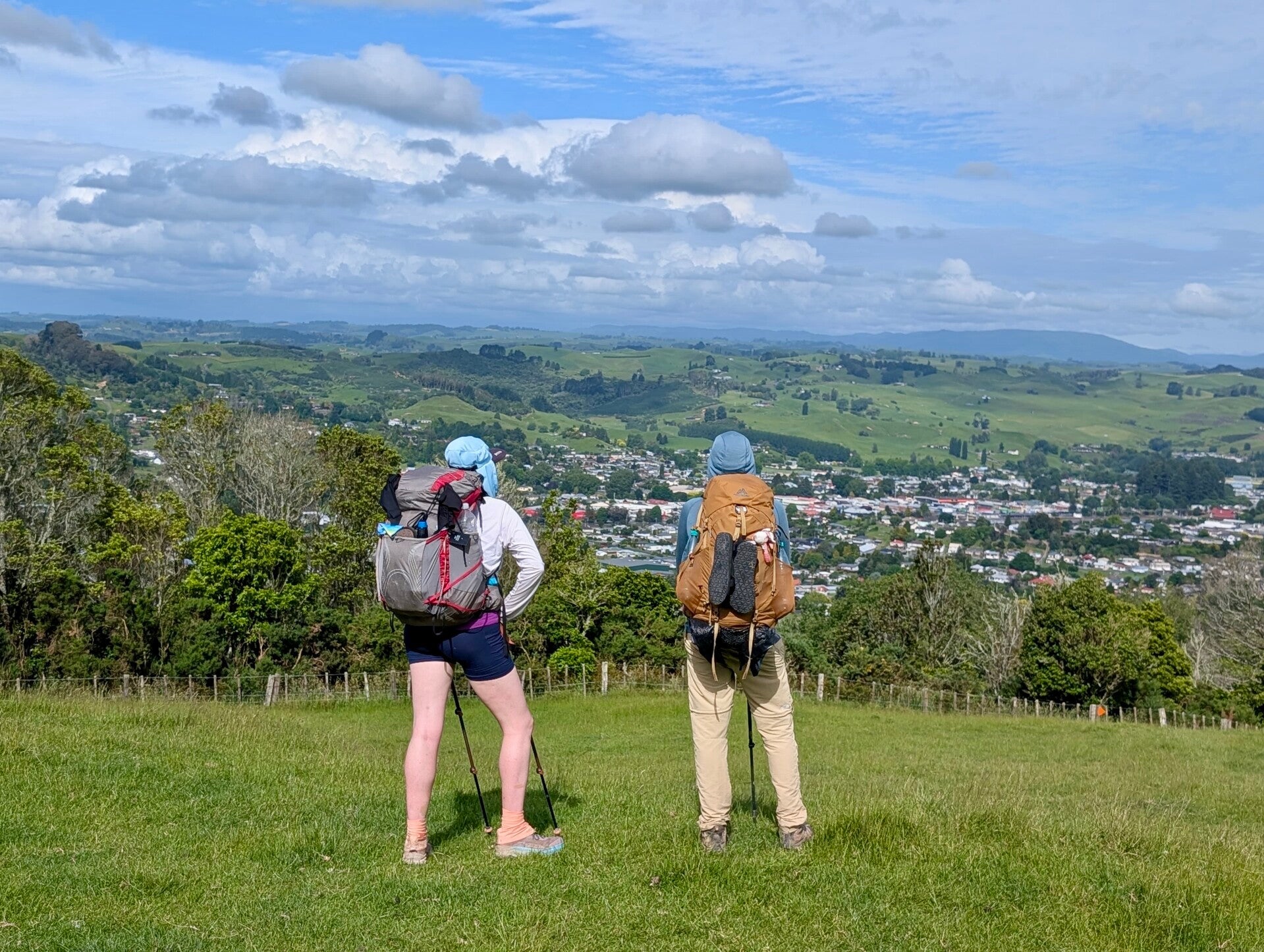
In the afternoon, we set off again for another 15 kilometers of hiking to the town of Te Kuiti. We cross several valleys at right angles, so we have to constantly climb, cross a ridge, descend, walk in the valley bottom, and climb up the other side… the trail is very muddy, and it takes us six hours to cover the fifteen kilometers. The four of us spend the night in a motel.
It was a long, but very beautiful day!



Add comment
Comments